A Look Back at 80 Years
Eighty years hold more than a single timeline can capture. What follows traces some of the milestones and turning points that shaped Lake Michigan College. What’s important to remember is that behind each one are the faculty, staff, students, and community members whose drive and dedication built the LMC we know today.
Look Back 1940s
: Backed by the G.I. Bill, the flood of WWII veterans eager for a college education overwhelms the country’s higher education system. To address the need for college access locally, Benton Harbor Superintendent Sidney Mitchell proposes establishing Benton Harbor Junior College. The Benton Harbor School Board votes in favor of the proposal.
: Benton Harbor School District voters approve funding for the Junior College.
: Dr. Clarence G. Beckwith, the head of the history department at the University of South Dakota, becomes dean of Benton Harbor Junior College.
: The first class of 78 students enrolls in Benton Harbor Junior College; classes meet in the evenings at the high school. Tuition is $75 per semester. On Sept. 9, Gloria Vanderbeck is the first student to ever enroll in the College, as reported by The News-Palladium. The average age of the first class is 22, and almost half are veterans. Classes begin Sept. 11.
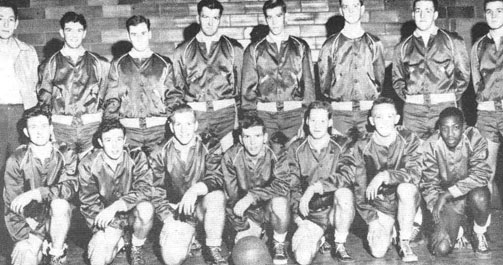
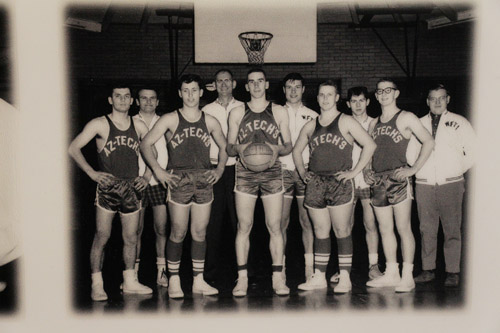
: The College launches its intercollegiate athletics program with a 10-member men’s basketball team coached by Don Farnum. Its eight-game season begins on the road at Jackson Junior College on Nov. 26. Additional sports planned are swimming, tennis, and golf.
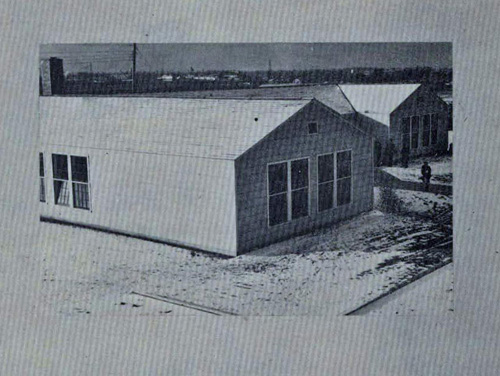
: Construction begins on a new Benton Harbor Junior College building on the Benton Harbor High School campus at the corner of Colfax and Empire. Four U.S. Army “magazine” buildings, provided by the War Assets Administration, are shipped from Illinois in 7-foot panel sections to be reassembled into one building with six classrooms and a library. Other fixtures and materials come from Willow Run Air Field, Green River Ordnance Plant, and Camp Ellis.
: The new Benton Harbor Junior College building, started in April, is complete. It makes daytime classes possible for the first time.
: The Warrior, the new student publication for Benton Harbor Junior College, is first published.
: Fall enrollment stands at 180 students.
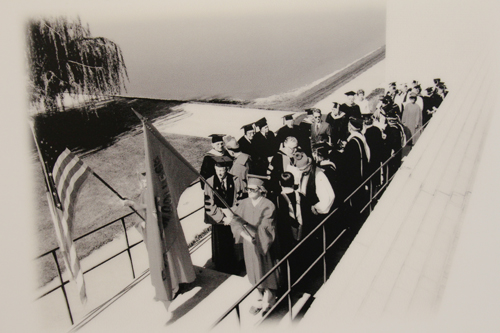
: Twenty-eight students make up the first Benton Harbor Junior College graduating class. Commencement exercises are held May 30 in the Benton Harbor High School auditorium. Graduates are from Benton Harbor, St. Joseph, Covert, Sawyer, and South Haven. The College’s first yearbook, The Tribesman, is published.
: Classes move to the refurbished Central School to accommodate growing enrollment.
: The men’s basketball team, coached by Eugene (Gene) Morgan, wins the Michigan Conference Championship and makes its first national tournament appearance. The community launches a fundraising drive to cover the cost of the team’s trip to Hutchinson, Kansas.
Look Back 1950s
: The men’s basketball team, coached by Gene Morgan, places fourth at the NJCAA National Tournament in Hutchinson, Kansas.
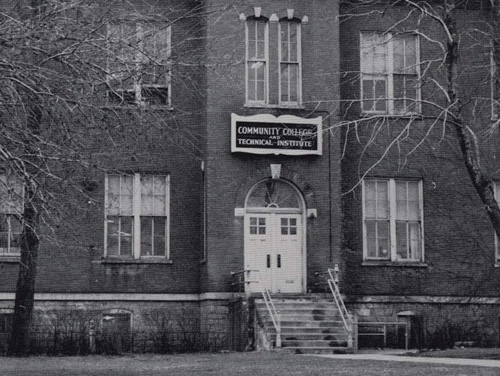
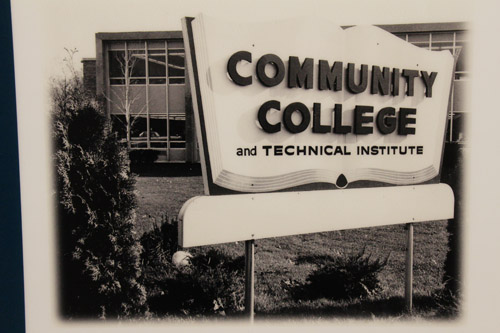
: The Benton Harbor School Board changes the Benton Harbor Junior College name to Community College and Technical Institute (CCTI) in recognition of the expanded role the College has in training the local workforce.
: Dr. Clarence Beckwith becomes the first president of the Community College and Technical Institute, as the Benton Harbor School Board renames the role from Dean to President.
: Whirlpool Foundation pledges $500,000 to establish a school of technology as a division of CCTI.
: Alumni from eight of the first 10 graduating classes gather to form the Alumni Association of Benton Harbor Community College.
: Students help move books and furnishings to the new campus on Britain Avenue after the fire marshal condemns the Central School building; classes officially begin in the new location.
Look Back 1960s
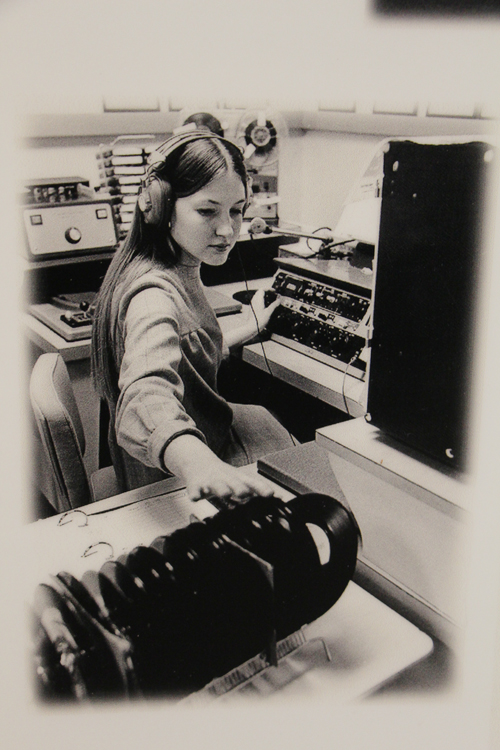
: CCTI launches its own radio station, WCCTI, a closed-circuit station that broadcasts in the student union.
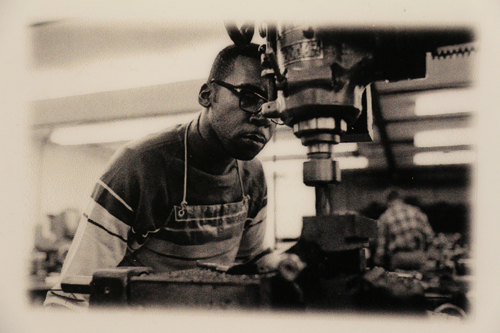
: Whirlpool Foundation commits $500,000 to build a 21,000-square-foot Technical Institute on the Britain Avenue Campus.
: President Dr. Clarence Beckwith retires from CCTI after 16 years as the College’s head administrator; Dr. Robert Lahti of Wyoming begins as the College’s second president.
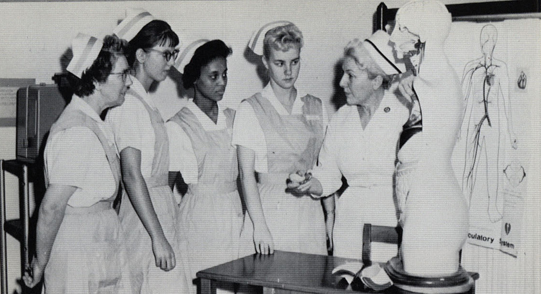
: The licensed practical nursing program launches with 22 students, marking the beginning of the College’s Health Sciences program.
: Construction of the Louis Cassius Upton Memorial Technical Center on the College’s Britain Avenue Campus is complete.
: Berrien County voters pass a ballot proposal creating a countywide college. They also elect a six-member independent Board of Trustees to oversee the College. The trustees are Dr. A.F. Bliesmer, Justin Condon, Beryl Dominy, Emily Foster, Dr. Bernard C. Radde, and Robert Small.
: On July 1, the Benton Harbor School District hands over operations of the College to the newly formed independent Board of Trustees. On this day, Community College and Technical Institute becomes Lake Michigan College.
: Dr. Robert Lahti resigns as president effective Oct. 9.
: A three-member administrative committee is named to run the College until a new president can be selected. They are Jerry Solloway, Dean of Students; Clarence Schauer, Dean of Instruction; and Henry Brown, Administrative Assistant.
: The Board of Trustees purchases 259 acres in Benton Township for the proposed Lake Michigan College campus to be located on Napier Avenue.
: Dr. Robert Plummer, an Assistant Dean at the University of Michigan-Flint, is selected as Lake Michigan College’s third president.
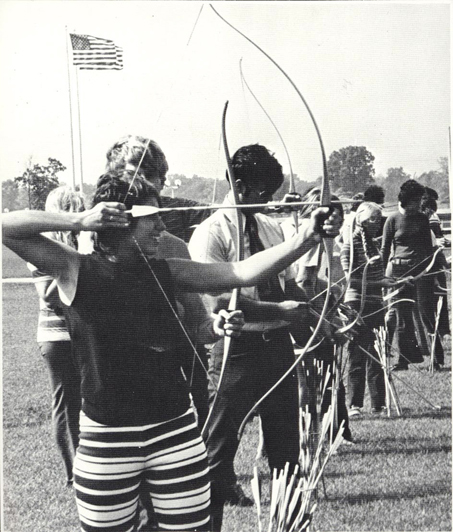
: LMC pauses its intercollegiate athletic program and begins an intramural program.
: The proposed design for the Benton Harbor Campus on Napier Avenue is presented to the Board of Trustees by Chicago architectural firm Harry Weese & Associates.
: Dr. Plummer resigns as president effective June 30. Dr. James Lehman, from Gogebic Community College, is hired as Lake Michigan College’s fourth president to start July 1.
: Construction of the College’s campus on Napier Avenue begins.
: LMC faculty go on strike following an impasse in negotiations that have been underway since April.
: Following a five-week strike, College faculty return to the classroom under an arbitration agreement.
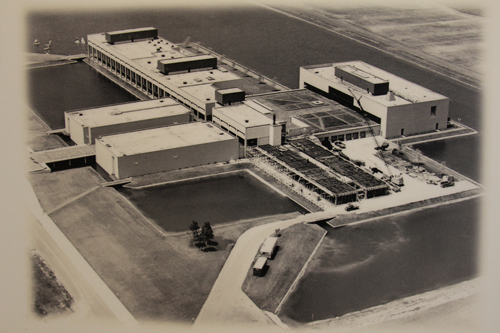
: Phase I construction of the Benton Harbor Campus (long known as the Napier Avenue Campus) is complete; many fall semester classes move to the new location. Phase I includes the library, student union, and classrooms (C-Wing).
: Phase II construction begins on the Benton Harbor Campus.
: Covert Township voters approve a proposal to join the Lake Michigan College district.
Look Back 1970s
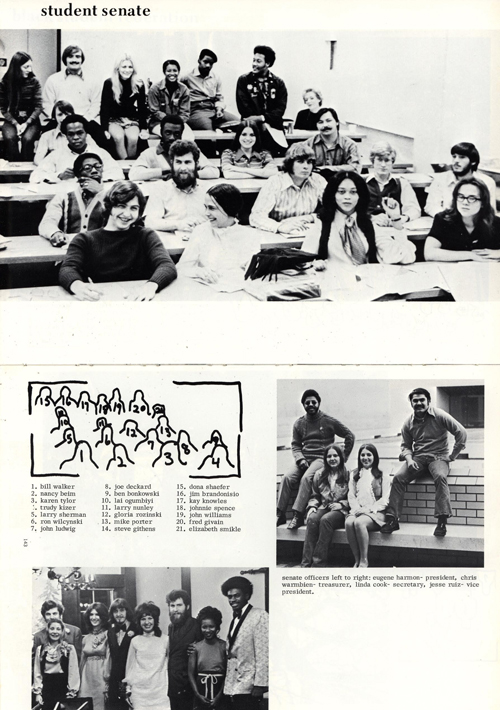
: The Board of Trustees votes to have the College return to intercollegiate athletic competition beginning in the fall of 1971.
: Phase II of the Benton Harbor Campus is complete; all remaining Britain Avenue operations, except the Technical Institute, move to the new location. Phase II includes two lecture halls, a gymnasium, a planetarium, a health education center, and third-floor administrative offices.
: Intercollegiate athletics return to LMC with cross country, golf, track, and basketball.
: Construction on Phase III (B-Wing) of the Benton Harbor Campus begins.
: Faculty go on strike after six months without a contract. Citing a Michigan law prohibiting strikes by public employees, college officials fire 54 full-time faculty who refuse to return to work. The U.S. Sixth Circuit Court of Appeals upholds the action in 1975, ruling that dismissing striking teachers does not violate their 14th Amendment rights.
: The Phase III (B-Wing) third floor opens for classes while floors one and two await completion.
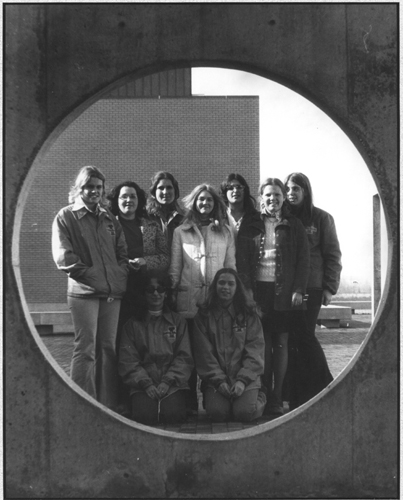
: The LMC Board of Trustees votes to establish a women’s intercollegiate athletics program beginning with the 1974–75 season.
: College officials dedicate the new Benton Harbor Campus.
: College officials detonate explosives to break ground on the new $6 million Community Center on the Benton Harbor Campus.
: President Lehman resigns; Dr. Walter Browe is named interim president effective immediately.
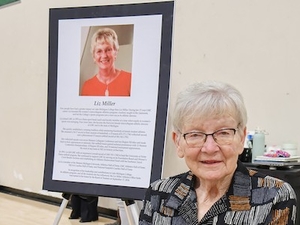
: Liz Miller, who joined LMC in 1974 as softball, volleyball, and women’s basketball coach, becomes the first female athletic director at LMC and continues coaching softball and volleyball.
: Dr. Walter Browe is chosen as Lake Michigan College’s fifth president after serving as interim president for two months.
: Two hundred people attend the dedication of the new Community Center; the performing arts theater interior remains unfinished, awaiting funding.
Look Back 1980s
: LMC student-athlete Sheila Atcher wins the NJCAA Women’s Long Jump National Championship in San Angelo, Texas.
: The South Campus opens in Niles at the former Westside School site.
: Siena Heights University enters an agreement with LMC to offer on-campus bachelor’s degree programs.
: Dr. Walter Browe announces his retirement as College president effective June 1985.
: An organizational committee forms to create the current-day version of the Lake Michigan College Alumni Association.
: The Board of Trustees chooses Dr. Anne E. Mulder as Lake Michigan College’s sixth president. Her tenure begins in June 1985.
: The College establishes the Lake Michigan College Educational Fund, Inc., commonly known as the LMC Foundation, to manage donations to the College.
: Distance learning classes debut at LMC with telecourses offered on tape and on local cable access channels.
Look Back 1990s
: College officials launch a campaign to raise funds to finish the Community Center.
: The College and community celebrate the completion of the Community Center’s 1,550-seat theater and its renaming to the Mendel Center for Arts & Technology.
: The women’s softball team wins the NJCAA National Championship in Hutchinson, Kansas, led by coach Kathy Letke. The team finishes with a season record of 50-6, the most wins in school history at the time.
: Dr. Anne Mulder retires as the sixth president of Lake Michigan College. Greg Koroch, Vice President of Institutional Advancement and Planning, is named interim president.
: Dr. Richard Pappas begins as the seventh president of Lake Michigan College.
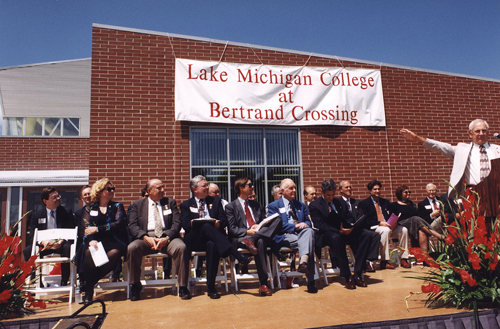
: College officials break ground on the Bertrand Crossing Campus in Niles; construction is funded primarily through a state grant and private donations.
: The Bertrand Crossing Campus in Niles opens; the College officially moves its South Campus operations to the new facility.
: The College breaks ground on two new projects: M-TEC in the City of Benton Harbor, and the One Stop Student Services Center, a $4 million renovation on the Benton Harbor Campus.
: The U.S. Department of Education awards a $1.75 million Title III grant to equip every classroom with teaching and learning technology and expand online classes.
Look Back 2000s
: M-TEC and the One Stop Student Services Center open with ribbon-cutting ceremonies. M-TEC provides expanded space for manufacturing courses previously conducted in B-Wing on the Benton Harbor Campus. The One Stop Student Services Center provides a welcoming “front door” to the Benton Harbor Campus and expanded space to serve students’ admissions, enrollment, and advising needs.
: The library is rededicated as the William Hessel Library in honor of the late William Hessel, who was dean of the library from 1957 until his retirement in 1986.
: Western Michigan University breaks ground on a satellite campus building on the Benton Harbor Campus. The new location will give students access to transfer programs and courses with less need to travel to WMU’s Kalamazoo campus.
: Voters of the South Haven Public School District approve joining the LMC district during a special election.
: Western Michigan University-Southwest cuts the ribbon on its new facility on the LMC Benton Harbor Campus.
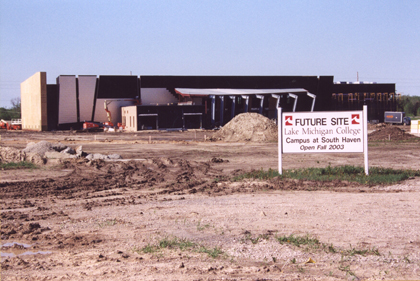
: LMC officials break ground on a South Haven Campus facility.
: South Haven Campus opens with more than 300 students enrolled. The expansion provides greater access to college classes, programs, and services for those in the northern portion of the College’s district.
: Dr. Richard Pappas resigns as president. He leaves to become president of National Louis University in Chicago. LMC Dean of Occupational Studies Robert Harrison is tapped as interim president.
: Dr. Randall Miller becomes the eighth Lake Michigan College president.
: The new Medical Imaging Career Center opens on the Benton Harbor Campus. The expansion allows for the addition of Diagnostic Medical Sonography to the College’s program offerings.
: Dr. Randall Miller resigns as president. For a second time, Dr. Robert Harrison becomes interim president.
: The Board of Trustees makes Dr. Robert Harrison’s role as president permanent. He officially assumes that title July 1, becoming the ninth Lake Michigan College president.
: A portion of the College’s M-TEC facility is leased as the temporary clubhouse for the Golf Club at Harbor Shores.
Look Back 2010s
: The final phase of a $9 million science wing renovation is complete. The 11 classrooms and more than 1,000 scientific models and equipment replace classrooms and laboratories dating back to 1968.
: The Red Hawk becomes the new college mascot, replacing the Indians, a name in use since 1946. The new mascot allows the College to maintain its historic connection with the Pokagon Band of Potawatomi, with whom it worked on the change.
: The College awards 551 degrees and certificates, an LMC record at the time.
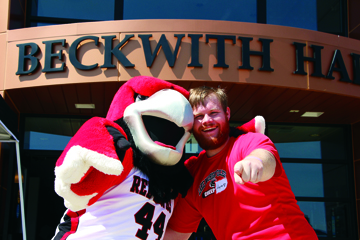
: College officials break ground on Beckwith Hall, the first on-campus living option for students in the history of the College.
: The Hawk’s Nest Student Activities Center opens on the Benton Harbor Campus. It gives students a space to gather, study, or relax between classes.
: The Higher Learning Commission approves LMC’s first Bachelor of Applied Science degree. The Energy Production and Distribution Management program focuses on the energy industry’s workforce training needs.
: Beckwith Hall opens during a public dedication ceremony and tours of the residence hall. The addition reflects a growing trend of community colleges offering on-campus housing.
: Whirlpool Corporation purchases M-TEC; the College plans to move manufacturing and technical training to the Benton Harbor Campus once a new facility is complete.
: In support of a growing wine industry in Michigan and the Midwest, the College establishes Lake Michigan Vintners as the first commercial teaching winery in the Midwest, serving Wine & Viticulture Technology students.
: In preparation for moving M-TEC classes to the Benton Harbor Campus, construction begins on the new advanced manufacturing technology center.
: LMC launches its Allegan County Early/Middle College program. The program enables students to earn both their high school diploma and associate’s degree in five years.
: The College receives a $17 million capital outlay grant from the State of Michigan for renovations to the Benton Harbor Campus.
: Dr. Robert Harrison retires as the ninth president of Lake Michigan College.
: Dr. Jennifer Spielvogel begins her term as Lake Michigan College’s 10th president. Her tenure ends on May 5, 2016.
: Dr. Robert Harrison returns to LMC as President Emeritus and Acting CEO following the end of Dr. Jennifer Spielvogel’s tenure.
: LMC establishes the fifth-year Early/Middle College program in Berrien County. The program is offered in partnership with Berrien RESA.
: The Hanson Technology Center, named for Merlin Hanson, opens with a ribbon-cutting in advance of fall classes. In addition to relocating manufacturing to the Benton Harbor Campus, the facility provides the community with a new “Fab Lab” with a host of fabrication equipment for student and community use.
: The Economic Club of Southwest Michigan transfers ownership and operation of its speaker series to the College.
: Dr. Trevor Kubatzke begins his tenure as Lake Michigan College’s 11th president.
: Work begins on $33 million in projects as part of the Benton Harbor Campus renovation. Funding comes from an $8.4 million state grant, a $7.5 million fundraising campaign, and a 10-year capital millage. The projects are expected to be complete in 2020.
: LMC purchases the WMU-Southwest building to house business, information technology, and criminal justice classes, and dedicates it as the Todd Center in August of the same year.
: The Welch Center for Wine & Viticulture opens on the Benton Harbor Campus. The new facility houses the Wine & Viticulture Technology program and Lake Michigan Vintners teaching winery.

Look Back 2020s
: Remote work and class delivery begin in response to the COVID-19 outbreak; the campus reopens four months later in July with safety protocols in place.
: The College completes its Campus Transformation project on the Benton Harbor Campus. Upgraded areas include both lecture halls, 50 classrooms, and mechanical and electrical infrastructure, and the project adds new learning spaces, a new service center, and equipment to improve comfort and energy efficiency.
: The LMC Promise is unveiled, providing free tuition to qualified students. This removes financial barriers for students and provides greater access to a college education.
: Olivia Ippel wins the NJCAA Division II Women’s Cross Country National Championship.
: The Bertrand Crossing Campus becomes a countywide Career and Technical Education center; LMC retains use of the facility for classes.
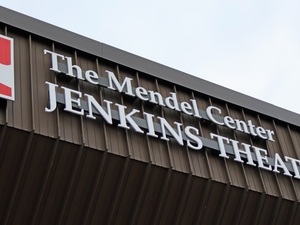
: The Mendel Center Mainstage is renamed the Mendel Center Jenkins Theatre in honor of long-time supporter Rolfe Jenkins.
: Planning begins for a second residence hall on the Benton Harbor Campus in response to an annual waitlist for on-campus housing.
: New softball, baseball, and soccer fields are complete; the softball facility is dedicated as the Liz & Lloyd Miller Family Field. The new fields replace poorly drained and often unplayable facilities built in the 1970s.
: Dr. Trevor Kubatzke retires as Lake Michigan College president.
: Southwest Michigan native, LMC alum, and long-time LMC faculty member and administrator Dr. Ken Flowers becomes the 12th Lake Michigan College president.